How Does Travel Medical Insurance Work for Visitors to the USA?

How does travel medical insurance work for visitors to the USA?
Travel medical insurance, often called visitor insurance, is temporary medical coverage for international travelers visiting the United States.
It is designed to help pay eligible medical expenses if the traveler becomes unexpectedly sick or injured during the covered trip. This article focuses only on the medical insurance process for visitors to the USA.
How Travel Medical Insurance Works at a Glance
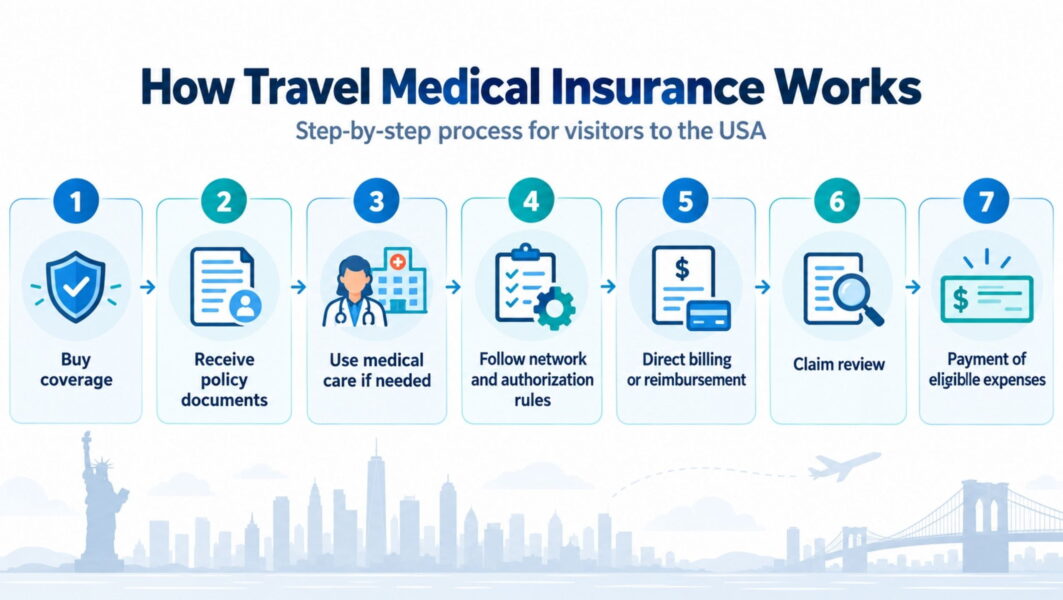
The process usually works like this:
Buy coverage → Receive policy documents → Use medical care if needed → Follow network and authorization rules → Direct billing or reimbursement → Claim review → Payment of eligible expenses
| Step | What Happens |
|---|---|
| 1 | Buy a visitors insurance plan online |
| 2 | Receive the policy and insurance ID card over email |
| 3 | Check the PPO network if care is needed |
| 4 | Seek medical treatment |
| 5 | Contact the insurer when required |
| 6 | Provider bills the insurer, or you pay upfront |
| 7 | Claim is reviewed |
| 8 | Eligible expenses are paid according to the policy |
If you never need medical care, the visitor insurance policy remains available for the duration of the coverage period.
Step 1: Buy the Visitors Insurance Policy
Once you have selected a plan, visitors insurance can usually be purchased online.
You may be asked for information such as:
- Traveler name
- Date of birth
- Home country or residency
- Travel dates
- Destination
- Contact details
The exact information varies by insurer. After payment, the policy is generally issued electronically and sent to you over email.
Step 2: Receive Your Policy Documents
After purchase, you will normally receive documents such as:
- Insurance certificate
- Insurance ID card
- Schedule of benefits
- Policy or certificate wording
- Claims instructions
- Emergency assistance information
Save these documents somewhere you can access easily during the trip. It is useful to keep copies:
- On your phone
- In your email
- In cloud storage
- With a family member
Carry the insurance ID card or keep a digital version available.
Step 3: Understand Your Medical Maximum, Deductible and Coinsurance
Before you need medical care, know how your plan works.
Medical Maximum
The medical maximum is the most the plan may pay for eligible medical expenses, subject to policy terms.
Deductible
The deductible is the amount the traveler may need to pay toward eligible expenses before certain benefits begin.
Coinsurance
Some plans also require the traveler to pay a percentage of eligible medical expenses after the deductible, known as coinsurance. For example, a plan may cover part of the eligible expense with the traveler paying the remaining percentage. The exact structure varies by policy.
Step 4: Use the PPO Network When Practical
Many comprehensive visitors insurance plans provide access to a PPO network.
A PPO network includes participating doctors, hospitals, urgent-care centers, and other medical providers that have agreed to negotiated rates.
Using an in-network provider may help with:
- Access to negotiated rates
- Medical claims processing
- Provider familiarity with the claims administrator
- Possible direct billing
However, PPO access does not guarantee direct billing.
A network provider may still ask you to pay at the time of treatment. For non-emergency care, check the provider network and ask how the provider plans to bill you before treatment.
Step 5: Seek Medical Care if You Become Sick or Injured
What you should do depends on the seriousness of the condition.
In an Emergency
Seek medical care immediately.
Examples can include:
- Serious injury
- Severe chest pain
- Stroke symptoms
- Major accident
- Serious breathing problems
- Other life-threatening conditions
Do not delay emergency care while trying to contact the insurer. Once the traveler is stable, contact the insurance company or assistance service as soon as reasonably possible.
For Non-Emergency Care
If the situation is not an emergency:
- Check the PPO network
- Find a participating provider when practical
- Show your insurance information
- Ask whether direct billing is available
- Check whether prior authorization is required
Step 6: Contact the Insurer When Required
Some treatments may require notification or prior authorization.
Depending on the policy, this may apply to:
- Planned hospitalization
- Surgery
- Certain diagnostic procedures
- Major non-emergency treatment
- Medical evacuation
If prior authorization is required but not obtained, benefits may be reduced or denied according to the policy.
In an emergency, seek care first.
Then contact the insurer or assistance service as soon as reasonably possible.
Keep the following information ready:
- Policy number
- Traveler name
- Hospital or clinic name
- Doctor information
- Contact details
Step 7: How Is the Medical Bill Paid?
Medical bills are generally handled in one of two ways.
| Billing Method | How It Works |
|---|---|
| Direct billing | Provider sends the bill to the insurer or claims administrator |
| Reimbursement | Traveler pays first and submits a claim afterward |
The billing method does not determine whether the expense is covered. The insurer is still reviewing the claim in accordance with the policy.
Direct Billing
With direct billing, the healthcare provider submits the medical charges to the insurer or claims administrator.
The traveler may still be responsible for:
- Deductible
- Coinsurance
- Copayment
- Non-covered services
- Amounts above applicable limits
Direct billing does not mean the claim is automatically approved.
It also does not guarantee completely cashless treatment.
Reimbursement
If the provider requires upfront payment, the traveler pays the bill and submits a claim.
This can happen with:
- Doctor visits
- Urgent-care visits
- Diagnostic services
- Pharmacy expenses
- Other outpatient treatment
Keep:
- Itemized bills
- Medical records
- Receipts
- Proof of payment
These may be needed for the claim.
How Do the Deductible and Coinsurance Work?
Suppose an eligible medical expense is $2,000.
Assume the plan has:
- $250 deductible
- Insurer pays 80% after the deductible
- Traveler pays 20% coinsurance
| Calculation | Amount |
|---|---|
| Eligible medical expense | $2,000 |
| Deductible | $250 |
| Remaining eligible expense | $1,750 |
| Insurer pays 80% | $1,400 |
| Traveler coinsurance | $350 |
| Total traveler responsibility | $600 |
This is only a simplified example. Actual amounts may differ because of:
- Network discounts
- Copayments
- Benefit limits
- Exclusions
- Eligible-charge calculations
- Other policy terms
Step 8: Submit a Medical Claim if Needed
If you paid for treatment yourself, you may need to submit a reimbursement claim. Common documents can include:
| Document | Why It May Be Needed |
|---|---|
| Claim form | Starts the claim |
| Itemized medical bill | Shows services and charges |
| Medical records | Explains diagnosis and treatment |
| Proof of payment | Shows what you paid |
| Prescription receipts | Supports medication expenses |
| Policy information | Identifies the insurance |
| Travel documents | May confirm eligibility |
Requirements vary by insurer. Submit the claim within the deadline stated in the policy.
What Happens After the Claim Is Submitted?
The insurer or claims administrator reviews the claim. They may check:
- Whether the policy was active
- Whether the illness or injury is covered
- Medical necessity
- Policy exclusions
- Pre-existing condition provisions
- Deductible
- Coinsurance
- Medical maximum
- Prior authorization requirements
- Supporting medical records
Possible outcomes include:
| Outcome | What It Means |
|---|---|
| Approved | Eligible expenses are paid according to the policy |
| Partially approved | Some expenses are paid, and others are excluded |
| More information required | Additional documents are needed |
| Denied | The expense does not qualify under the policy |
Receiving medical treatment does not automatically mean the claim will be paid. The expense must meet the policy terms.
Example: How Visitors Insurance Works From Start to Finish
Suppose a parent from India is visiting family in the USA. Before the trip, the family buys visitors insurance. The traveler receives:
- Policy documents
- Insurance ID card
- PPO network information
- Emergency assistance details
During the visit, the traveler develops severe abdominal pain and goes to an emergency room. The hospital provides treatment and decides that hospitalization is required. The family contacts the insurance administrator after the emergency situation is under control.
If Direct Billing Is Available
The hospital sends the medical charges to the claims administrator. The insurer then reviews:
- Whether the condition is covered
- Eligible medical expenses
- Deductible
- Coinsurance
- Network rates
- Medical records
- Policy exclusions
The insurer pays eligible expenses in accordance with the policy. The traveler remains responsible for applicable deductibles, coinsurance, copayments, and non-covered charges.
If Upfront Payment Is Required
The traveler or family pays the provider. They then submit the required documents for reimbursement. The insurer reviews the claim and reimburses eligible expenses in accordance with the policy.
If You Buy Visitors Insurance for Your Parents
Adult children in the USA often buy visitors insurance for parents visiting from abroad. If you purchase the policy for your parents, keep copies of:
- Policy number
- Insurance ID card
- PPO network information
- Claims administrator details
- Emergency assistance number
- Claims instructions
Remember that your parent is the insured traveler. Healthcare providers or insurers may require your parent’s authorization before discussing medical information or claims with you. Arranging any required authorization in advance can make the process easier.
What About Pre-Existing Conditions?
Many visitors insurance plans exclude routine treatment for pre-existing conditions. Some plans may provide limited benefits for an acute onset of a pre-existing condition.
An acute onset generally refers to a sudden and unexpected recurrence or worsening that meets the policy definition and requires immediate medical attention.
Coverage varies by plan and may depend on:
- Age
- Benefit limits
- Timing requirements
- Exclusions
- Policy definitions
Do not assume that any/all pre-existing conditions are covered. Review the policy before travel.
Important Things to Do Before Your Trip
After buying the policy:
- Read the schedule of benefits.
- Review major exclusions.
- Understand the deductible.
- Check whether coinsurance applies.
- Save the insurance ID card.
- Save the emergency assistance number.
- Know how to find PPO providers.
- Understand how claims are submitted.
- Review pre-existing condition provisions.
- Check activity exclusions if you plan sports or adventure activities.
Understanding the policy before treatment is much easier than learning it during a medical emergency.
Common Misunderstandings About Visitors Insurance
“The Insurance Card Means the Hospital Will Bill the Insurer”
Not necessarily. The provider may still require payment upfront.
“Using a PPO Provider Guarantees Direct Billing”
No. PPO access and direct billing are different.
“Direct Billing Means the Claim Is Approved”
No. The insurer still reviews whether the expense is covered.
“The Insurer Pays Everything After the Deductible”
Not always. Coinsurance, copayments, exclusions, or benefit limits may still apply.
“Pre-Existing Conditions Are Automatically Covered”
No. Coverage varies by plan.
“I Must Contact the Insurer Before Emergency Treatment”
For a serious emergency, seek medical care first. Then follow the policy’s notification requirements as soon as reasonably possible.
How Travel Medical Insurance Works: Key Takeaway
Travel medical insurance for visitors to the USA generally works like this:
Buy coverage → Keep your policy information → Seek medical care if needed → Use the network when practical → Follow authorization requirements → Direct billing or reimbursement → Claim review → Payment of eligible expenses
The most important point is that having an insurance card does not mean every medical bill will be paid automatically.
Coverage depends on:
- Whether the medical expense is eligible
- Deductible
- Coinsurance
- Medical maximum
- Network rules
- Pre-existing condition provisions
- Exclusions
- Other policy terms
Understanding the process before traveling can make it much easier to use visitors insurance if medical care is needed in the United States.
Frequently Asked Questions
How Does Travel Medical Insurance Work in the USA?
You buy coverage for a defined travel period. If an eligible illness or injury occurs, the plan may pay covered medical expenses in accordance with its deductible, coinsurance, medical maximum, exclusions, and other policy terms.
Is Visitors Insurance the Same as Travel Medical Insurance?
Visitors insurance commonly refers to travel medical insurance purchased for international visitors, especially those visiting the USA.
Do I Have to Use a PPO Provider?
It depends on the plan. Some plans allow out-of-network treatment, but your cost-sharing or eligible amount may differ.
Does a PPO Provider Bill the Insurance Directly?
Not always. Ask the provider whether they will bill the insurer or claims administrator directly.
Do I Have to Pay Medical Bills Upfront?
Sometimes. Some providers may offer direct billing, while others require upfront payment followed by reimbursement.
Does Visitors Insurance Cover Hospitalization?
Eligible hospitalization may be covered if the illness or injury meets the policy terms. Deductibles, coinsurance, limits, exclusions, and authorization requirements may apply.
Does Visitors Insurance Cover Pre-Existing Conditions?
Coverage varies by plan. Some plans may provide limited benefits for an acute onset of a pre-existing condition or other specifically defined situations.
What Happens if My Claim Is Denied?
Review the reason for denial and the policy terms. If you believe the claim was incorrectly decided, follow the insurer’s appeal or reconsideration process.